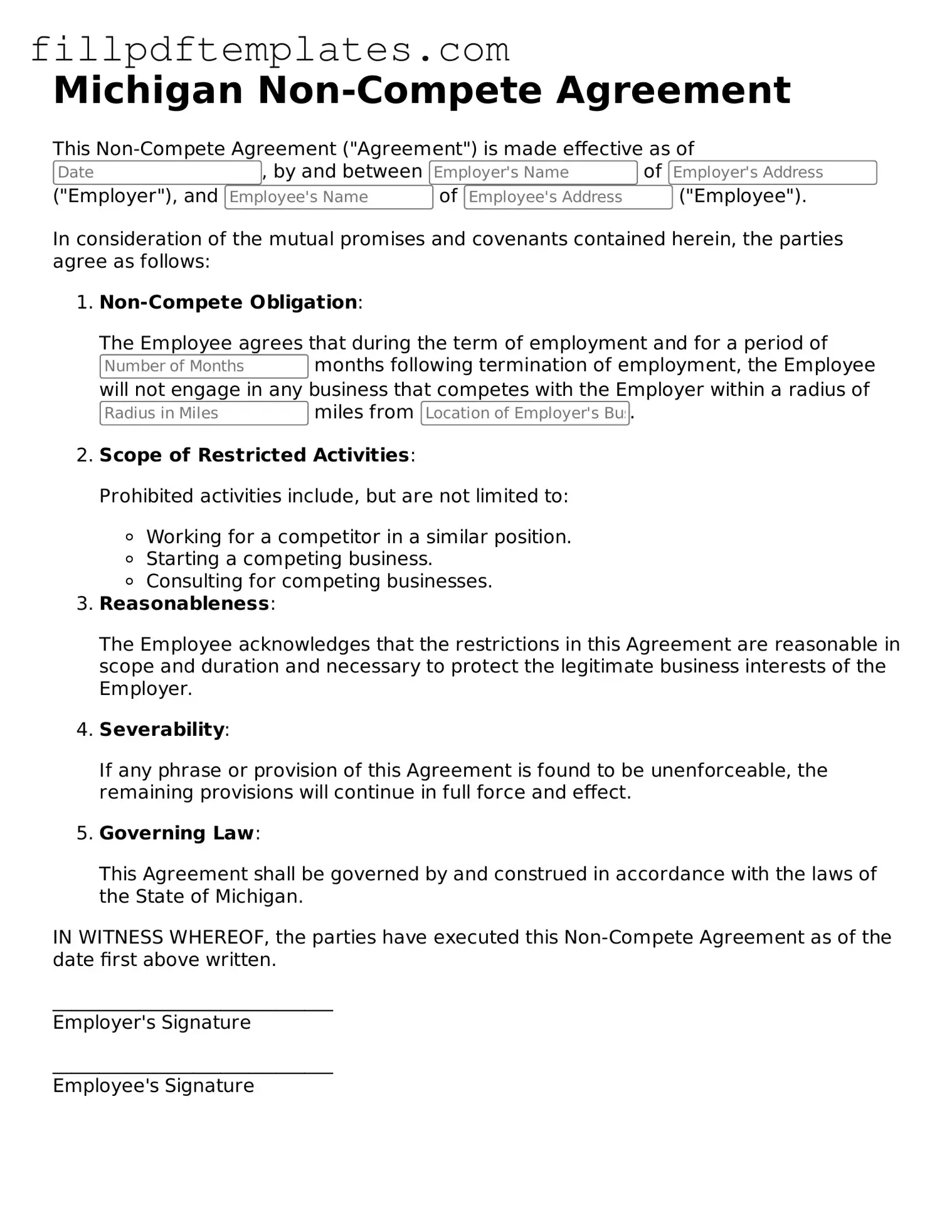
Blank Michigan Non-compete Agreement Form
In the realm of employment law, non-compete agreements play a significant role in shaping the relationship between employers and employees. Particularly in Michigan, these agreements serve to protect a company's proprietary information and competitive edge by restricting employees from working for competitors or starting similar businesses for a specified period after leaving the company. The Michigan Non-compete Agreement form outlines the essential elements necessary for such an agreement to be enforceable, including the duration of the restriction, the geographic area it covers, and the specific activities that are prohibited. Employers must carefully draft these agreements to ensure they are reasonable and not overly broad, as courts often scrutinize them for fairness. Moreover, employees should understand their rights and obligations under these agreements, as they can have significant implications for future employment opportunities. By examining the key components of the Michigan Non-compete Agreement form, individuals can better navigate the complexities of these legal documents and their impact on the workforce.
Other Common Non-compete Agreement State Templates
Noncompete New York - A non-compete agreement restricts employees from working for competitors after leaving a job.
In Connecticut, a Hold Harmless Agreement is an essential tool for managing risk, where one party commits to not hold the other accountable for any potential liabilities or damages. Such agreements are particularly important in service provision or property usage, as they help to mitigate legal complications from unexpected events. For those interested in learning more, visit the Hold Harmless Agreement page to gain a deeper understanding of its application and importance.
Are Non-competes Enforceable in California - Negotiating a shorter duration can help employees retain more job opportunities after leaving a company.
Similar forms
-
Non-disclosure Agreement (NDA): This document prevents individuals from sharing confidential information obtained during their employment or business relationship. Similar to a non-compete agreement, it protects business interests by restricting information flow.
-
Employment Contract: An employment contract outlines the terms and conditions of employment, including duties, compensation, and duration. Like a non-compete agreement, it establishes boundaries and expectations for both parties.
- Articles of Incorporation: This foundational document is necessary to legally incorporate a business in the state of Colorado. Filing the Colorado PDF Forms ensures compliance with state regulations and establishes the corporation's identity and purpose.
-
Confidentiality Agreement: This agreement ensures that sensitive information is kept private. Similar to a non-compete, it aims to protect a company's proprietary information and trade secrets from being disclosed.
-
Partnership Agreement: This document governs the relationship between business partners. It may include clauses that restrict partners from engaging in competing businesses, akin to the restrictions found in a non-compete agreement.
-
Severance Agreement: A severance agreement outlines the terms under which an employee leaves a company. It may include non-compete clauses to prevent the former employee from joining competing firms, similar to a non-compete agreement.
-
Consulting Agreement: This document defines the terms of a consulting relationship. It may include non-compete provisions to protect the interests of the hiring company, mirroring the protective nature of a non-compete agreement.
Document Properties
| Fact Name | Details |
|---|---|
| Definition | A non-compete agreement is a contract that restricts an employee from working for competitors after leaving a company. |
| Governing Law | The Michigan Non-Compete Agreement is governed by Michigan law, specifically under MCL 445.774a. |
| Enforceability | Non-compete agreements in Michigan are enforceable if they are reasonable in scope, duration, and geographic area. |
| Duration | The duration of the restriction should be limited; typically, agreements lasting one to two years are considered reasonable. |
| Geographic Scope | The geographic area covered by the agreement must be reasonable and related to the employer’s business interests. |
| Consideration | For a non-compete agreement to be valid, there must be consideration, such as a job offer or promotion. |
| Blue Pencil Rule | Michigan courts may apply the "blue pencil" rule, allowing them to modify unreasonable terms rather than voiding the entire agreement. |
| Exceptions | Certain professions, such as physicians, may have specific regulations that affect the enforceability of non-compete agreements. |
| Judicial Review | Michigan courts will review non-compete agreements on a case-by-case basis to ensure they meet legal standards. |
Things You Should Know About This Form
-
What is a Non-compete Agreement?
A Non-compete Agreement is a legal contract between an employer and an employee. It restricts the employee from engaging in business activities that compete with the employer's business for a specified period of time and within a certain geographical area after leaving the company.
-
Why would an employer use a Non-compete Agreement?
Employers use Non-compete Agreements to protect their business interests. These agreements help to safeguard confidential information, trade secrets, and customer relationships from being used by former employees to benefit a competitor.
-
Are Non-compete Agreements enforceable in Michigan?
Yes, Non-compete Agreements can be enforceable in Michigan, but they must meet certain criteria. The agreement must be reasonable in terms of duration, geographic scope, and the type of employment restricted. Courts will evaluate these factors to determine if the agreement is fair and necessary for the protection of the employer's legitimate business interests.
-
How long can a Non-compete Agreement last?
The duration of a Non-compete Agreement in Michigan typically ranges from six months to two years. However, the specific time frame should be reasonable based on the nature of the business and the employee's role. Agreements that are too long may be deemed unenforceable.
-
What happens if I violate a Non-compete Agreement?
If you violate a Non-compete Agreement, your former employer may take legal action against you. This could include seeking an injunction to prevent you from working for a competitor or claiming damages for any losses incurred due to the violation. It's important to understand the potential consequences before signing such an agreement.
-
Can I negotiate the terms of a Non-compete Agreement?
Yes, you can negotiate the terms of a Non-compete Agreement. If you feel that certain terms are too restrictive or unfair, it is advisable to discuss your concerns with your employer before signing. Modifications can sometimes be made to better suit both parties.
-
What should I consider before signing a Non-compete Agreement?
Before signing a Non-compete Agreement, consider the following:
- Your career goals and future employment opportunities.
- The reasonableness of the agreement's terms.
- The potential impact on your ability to find work in your field.
- Consulting with a legal professional for advice.
-
Can I get out of a Non-compete Agreement?
Exiting a Non-compete Agreement can be challenging, but it is possible. You may seek to negotiate a release with your former employer or challenge the enforceability of the agreement in court. Legal advice can be beneficial in navigating this process.
Documents used along the form
When drafting a Michigan Non-compete Agreement, several other forms and documents may be needed to ensure clarity and legal compliance. These documents help define the terms of employment, protect sensitive information, and outline the responsibilities of both parties. Here’s a list of commonly used documents that accompany a Non-compete Agreement.
- Employment Agreement: This document outlines the terms of employment, including job responsibilities, salary, and duration of employment. It often serves as the foundation for the relationship between the employer and employee.
- Confidentiality Agreement: Also known as a Non-disclosure Agreement (NDA), this form protects sensitive information shared between the employer and employee. It ensures that proprietary information remains confidential.
- Intellectual Property Assignment Agreement: This document clarifies the ownership of any inventions or creative works developed by the employee during their employment. It typically assigns ownership to the employer.
- Transfer-on-Death Deed Form: This tool allows property owners in Oklahoma to designate beneficiaries for their real estate, simplifying the inheritance process and avoiding probate issues. For more information, visit https://transferondeathdeedform.com/oklahoma-transfer-on-death-deed/.
- Severance Agreement: If employment ends, this agreement outlines the terms of severance pay and any conditions attached to it. It may also include clauses related to non-compete and confidentiality.
- Offer Letter: This letter formally offers the job to the candidate and includes key details such as position, salary, and start date. It sets the stage for the subsequent agreements.
- Non-solicitation Agreement: This document prevents an employee from soliciting clients or employees from the company after leaving. It helps protect the business's relationships and workforce.
- Independent Contractor Agreement: If the worker is not an employee, this agreement outlines the terms of the contractor's work, including payment and deliverables. It may also contain non-compete and confidentiality clauses.
- Termination Letter: This letter formally ends the employment relationship. It may reference the terms of the Non-compete Agreement and outline any obligations the employee must fulfill after termination.
These documents play a crucial role in establishing clear expectations and protecting the interests of both parties involved. Having them in place can help prevent misunderstandings and legal disputes down the line.
Michigan Non-compete Agreement Preview
Michigan Non-Compete Agreement
This Non-Compete Agreement ("Agreement") is made effective as of , by and between of ("Employer"), and of ("Employee").
In consideration of the mutual promises and covenants contained herein, the parties agree as follows:
- Non-Compete Obligation:
- Scope of Restricted Activities:
- Working for a competitor in a similar position.
- Starting a competing business.
- Consulting for competing businesses.
- Reasonableness:
- Severability:
- Governing Law:
The Employee agrees that during the term of employment and for a period of months following termination of employment, the Employee will not engage in any business that competes with the Employer within a radius of miles from .
Prohibited activities include, but are not limited to:
The Employee acknowledges that the restrictions in this Agreement are reasonable in scope and duration and necessary to protect the legitimate business interests of the Employer.
If any phrase or provision of this Agreement is found to be unenforceable, the remaining provisions will continue in full force and effect.
This Agreement shall be governed by and construed in accordance with the laws of the State of Michigan.
IN WITNESS WHEREOF, the parties have executed this Non-Compete Agreement as of the date first above written.
______________________________
Employer's Signature
______________________________
Employee's Signature